
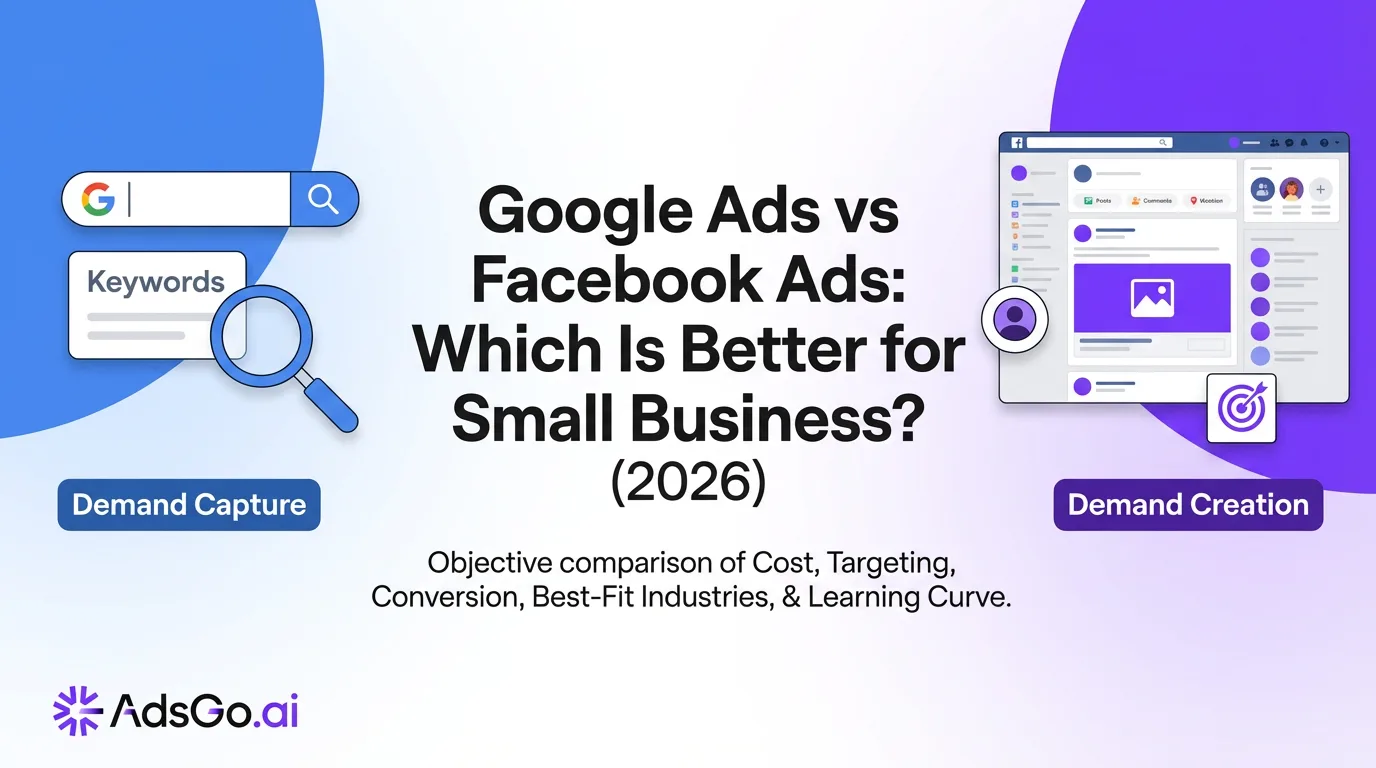
Google Ads captures existing demand — people actively searching for what you sell. Facebook Ads creates new demand — putting your product in front of people who didn't know they wanted it yet. Both platforms are profitable for small businesses, but they serve fundamentally different purposes, and choosing the wrong one (or using both incorrectly) wastes budget fast.
After managing cross-platform campaigns across 1,000+ small business accounts at AdsGo, the answer we give most often is: it depends on your business model, budget, and sales cycle. This guide gives you the objective data to make that decision — comparing Google Ads and Facebook Ads across cost, targeting, conversion speed, industry fit, and learning curve — so you can allocate your budget where it will generate the highest return.
Google Ads vs. Facebook Ads: The Complete Comparison
Head-to-Head Comparison Table
The differences become clearer when you compare them side by side.
| Factor | Google Ads | Facebook Ads | Winner For Small Business |
|---|---|---|---|
| Primary function | Captures existing search demand | Creates awareness and demand | Depends on your goal |
| Average CPC (2026) | $2.69 | $1.07 | Facebook (lower click cost) |
| Average CPM | $38.40 | $14.90 | Facebook (lower impression cost) |
| Average conversion rate | 4.40% (Search) | 1.85% | Google (higher intent traffic) |
| Average CPA | $48.96 (Search) | $19.68 (ecommerce avg.) | Industry-dependent |
| Targeting method | Keyword intent + demographics | Demographics + interests + behavior + Lookalikes | Facebook (richer targeting) |
| Audience reach | 8.5B+ daily searches | 3.07B monthly active users | Google (larger reach via Search + Display) |
| Best ad formats | Text (Search), Shopping, Video (YouTube) | Image, Video, Carousel, Stories, Reels | Facebook (more creative formats) |
| Conversion speed | Fast (hours to days) | Slower (days to weeks) | Google (faster for ready-to-buy users) |
| Retargeting strength | Moderate (Display Network) | Strong (pixel-based, cross-device) | Facebook (more precise retargeting) |
| Learning curve | Steep (keyword research, Quality Score, match types) | Moderate (creative-heavy, simpler bidding) | Facebook (easier to start) |
| Minimum viable budget | $1,500–$3,000/mo | $1,000–$2,000/mo | Facebook (lower entry point) |
| Best for | High-intent services, local search, B2B, ecommerce with search demand | Brand awareness, impulse purchases, visual products, audience building | Both (different strengths) |
(Sources: Meta Business Help Center; WordStream Industry Benchmarks, 2025; AdsGo internal campaign data)
Cost Comparison in Depth
Cost is usually the first question small businesses ask, but comparing raw CPC or CPM across platforms is misleading. What matters is cost-per-conversion — and that depends on your funnel, not just the platform.
| Cost Metric | Google Ads (Search) | Google Ads (Display) | Facebook Ads | Instagram Ads |
|---|---|---|---|---|
| Average CPC | $2.69 | $0.63 | $1.07 | $1.15 |
| Average CPM | $38.40 | $3.12 | $14.90 | $12.35 |
| Average CTR | 6.42% | 0.46% | 1.39% | 0.98% |
| Average CVR | 4.40% | 0.57% | 1.85% | 1.42% |
| Average CPA | $48.96 | $75.51 | $19.68 (ecom) / $52.00 (SaaS) | $24.50 (ecom) |
(Sources: Meta Business Help Center; WordStream Industry Benchmarks, 2025; AdsGo internal campaign data) The nuance: Google Ads' higher CPC is offset by higher conversion rates — users clicking a Google search ad are further down the funnel (they searched for your product). Facebook's lower CPC reaches more people, but a smaller percentage convert on the first visit. For businesses with longer sales cycles, Facebook's lower upfront cost plus retargeting often wins. For businesses where customers are ready to buy now, Google's higher-intent traffic delivers faster ROI.
Targeting Precision
Google and Facebook target audiences through fundamentally different mechanisms:
Google Ads targeting is intent-based. You choose keywords that match what people search for. A user searching "emergency plumber near me" has extremely high purchase intent — you don't need to convince them they need a plumber. Google also offers demographic and in-market audience layering, but keyword intent is the core.
Facebook Ads targeting is profile-based. You define your audience by demographics, interests, behaviors, and Lookalike audiences built from your existing customers. This allows you to reach people who match your ideal customer profile but may not be actively searching for your product. It's more creative-driven — you have to earn attention rather than capture it.
| Targeting Capability | Google Ads | Facebook Ads |
|---|---|---|
| Keyword intent | Core feature | Not available |
| Demographic targeting | Basic (age, gender, income) | Advanced (age, gender, education, job title, life events) |
| Interest targeting | In-market and affinity audiences | Detailed interest and behavior categories |
| Lookalike/Similar audiences | Similar Audiences (being deprecated) | Lookalike Audiences (1–10% range, highly effective) |
| Custom audiences | Customer Match (email lists) | Custom Audiences (email, phone, website, app activity) |
| Geographic precision | Excellent (zip code, radius) | Good (city, zip code, radius) |
| Device targeting | Full control | Full control |
| Retargeting | Display Network, RLSA | Facebook Pixel, cross-device |
For Facebook-specific audience targeting strategies, read our in-depth guide on how to find your target audience for Facebook Ads.
Conversion Speed and Sales Cycle
Google Ads wins for speed. A user searching "buy standing desk" can see your ad, click, and purchase within minutes. Google Search captures bottom-of-funnel intent — these users have already decided to buy and are comparing options.
Facebook Ads requires a longer path. A user scrolling Instagram sees your standing desk ad, maybe clicks through, browses your site, and leaves. They come back via a retargeting ad 3 days later, add to cart, and purchase 2 days after that. The total conversion cycle is 5–14 days for many products.
This doesn't make Facebook worse — it means the two platforms serve different parts of the buyer journey:
| Funnel Stage | Best Platform | Why |
|---|---|---|
| Awareness (never heard of you) | Facebook / Instagram | Visual formats excel at introducing products; no search intent needed |
| Consideration (researching options) | Both | Facebook retargeting keeps you top-of-mind; Google captures research searches |
| Decision (ready to buy) | Google Search | High-intent keywords capture users at the moment of purchase decision |
| Retention (past customers) | Retargeting and Lookalike audiences drive repeat purchases cost-effectively |
Which Industries Should Use Which Platform?
Based on performance data from 1,000+ small business accounts, here's where each platform typically delivers the highest ROI:
| Industry | Recommended Primary Platform | Why |
|---|---|---|
| Local services (plumbing, HVAC, legal) | Google Ads | High search intent — people Google "plumber near me," they don't discover plumbers on Facebook |
| Ecommerce (fashion, home, beauty) | Facebook Ads | Visual products thrive on image/video formats; impulse purchase behavior is strong |
| Ecommerce (electronics, high-research) | Google Ads | Buyers research specific models and compare prices via search |
| SaaS / B2B | Google Ads (primary) + Facebook (retargeting) | Decision-makers search for solutions by name; Facebook retargeting nurtures leads |
| Restaurants / Food delivery | Facebook Ads | Local awareness campaigns and visual food content drive foot traffic and orders |
| Online education | Facebook Ads (primary) + Google (branded) | Course discovery is impulse-driven; Google captures branded searches after awareness |
| Real estate | Both equally | Google captures "homes for sale in [city]" intent; Facebook builds awareness for agents |
| Health & wellness | Facebook Ads | Lifestyle-driven purchases respond well to visual storytelling and social proof |
| Professional services (accounting, consulting) | Google Ads | Clients search for specific services; trust is built through reviews, not social ads |
Learning Curve and Time Investment
For small businesses with limited marketing resources, the time required to learn and manage each platform matters.
Google Ads has a steeper learning curve. Keyword research, match types, Quality Score optimization, negative keyword management, bid adjustments, and ad extensions require significant learning. Most small businesses need 2–3 months to become competent and 6+ months to optimize effectively.
Facebook Ads is easier to start but harder to scale. The interface is more intuitive, and launching a basic campaign takes minutes. But performance depends heavily on creative quality and audience strategy — skills that develop over time. Scaling from $1,000/month to $10,000/month on Facebook requires a sophisticated understanding of audience segmentation, creative rotation, and budget allocation.
| Factor | Google Ads | Facebook Ads |
|---|---|---|
| Time to launch first campaign | 2–4 hours | 30–60 minutes |
| Time to become competent | 2–3 months | 1–2 months |
| Weekly management time | 3–5 hours (at $5K/mo spend) | 4–6 hours (at $5K/mo spend) |
| Key skill needed | Data analysis + keyword research | Creative production + audience strategy |
| Biggest ongoing challenge | Negative keyword management, Quality Score | Creative fatigue, audience saturation |
Ready to Launch Smarter Campaigns?
When to Use Both Platforms Together
Scenario 1: Ecommerce Brands
For most small businesses with $5,000+/month in ad budget, the highest-performing strategy uses both platforms in a coordinated funnel:
-
Facebook Ads for awareness and prospecting. Use video ads, carousels, and engaging creative to introduce your brand to cold audiences defined by Lookalike audiences and interest targeting. Goal: drive website visits and build retargeting pools.
-
Google Ads for intent capture. Bid on keywords related to your product and category. Users who saw your Facebook ads and later search for your brand or product category convert at significantly higher rates — typically 2–3x the conversion rate of users with no prior exposure.
Scenario 2: Lead Generation
Here are the key considerations to keep in mind.
-
Facebook retargeting for nurturing. Retarget website visitors, video viewers, and cart abandoners with specific messaging that addresses their objections and moves them toward conversion.
-
Google branded search for closing. Capture users who search your brand name after seeing Facebook or Instagram ads. Branded search campaigns typically deliver 8–15x ROAS because the user already knows and trusts your brand.
This cross-platform approach typically delivers 20–40% higher overall ROAS than either platform alone, because each platform handles the funnel stage it's best at.
For detailed ROAS optimization strategies, read our guide on how to improve Facebook Ads ROAS. To minimize costs across both platforms, see how to reduce Facebook Ads cost and how to lower Google Ads CPA with AI.
How AdsGo Manages Both Platforms From One Dashboard
Automated Creative Rotation
Running Google Ads and Facebook Ads simultaneously means managing two interfaces, two reporting systems, two sets of optimization rules, and twice the time investment. Most small businesses don't have the resources for that.
AdsGo's Ads Manager unifies both platforms in a single dashboard — so you can launch, monitor, and optimize Google and Meta campaigns without switching between tools or learning two systems.
AI-Powered Optimization
AdsGo AI automates several key parts of this optimization workflow, removing the manual effort that slows most teams down.
- Unified campaign management — Create and edit Google Search, Google Shopping, Facebook, and Instagram campaigns from one interface
- Cross-platform budget optimization — AI allocates your total ad budget across platforms and campaigns based on real-time performance, shifting spend to where it generates the highest return
- Single performance dashboard — See Google and Meta metrics side-by-side with unified ROAS, CPA, and conversion tracking
- One-click campaign launch — AdsGo Ads Launcher simplifies campaign creation with guided setup for both platforms, reducing launch time from hours to minutes
Whether you choose Google Ads, Facebook Ads, or both — AdsGo helps you manage them more efficiently and profitably than juggling native platforms alone.
Manage Google + Facebook Ads in one place with AdsGo →
FAQ
Which is cheaper: Google Ads or Facebook Ads?
Facebook Ads has lower average CPC ($1.07 vs. $2.69) and CPM ($14.90 vs. $38.40). However, Google Ads often has lower cost-per-conversion for high-intent products because search traffic converts at higher rates (4.40% vs. 1.85%). The truly "cheaper" platform depends on your conversion rate and average order value — compare CPA, not CPC.
Can I run both Google Ads and Facebook Ads on a small budget?
Yes, but with a minimum of $3,000–$5,000/month total. Below that, it's better to focus on one platform and do it well. If you choose to split, allocate 60% to the platform that best matches your industry (see the industry table above) and 40% to the other for testing.
How long does it take to see results from each platform?
Google Search Ads can generate conversions within 24–72 hours because users have immediate purchase intent. Facebook Ads typically take 7–14 days to exit Meta's learning phase and another 1–2 weeks to build enough data for meaningful ROAS assessment. Plan for a 30-day evaluation window on Facebook.
Is Facebook Ads still worth it in 2026 with iOS privacy changes?
Yes. While iOS 14.5+ tracking limitations reduced attribution accuracy, they didn't eliminate Facebook's targeting effectiveness. Meta's Conversions API, broad targeting with Advantage+, and AI-driven audience optimization have largely compensated. In our data, Facebook Ads ROAS averages are only 8–12% lower than pre-iOS 14.5 levels after accounting for underreported conversions — and for many advertisers, actual performance is flat or improved.
Should a new business start with Google Ads or Facebook Ads?
It depends on whether demand for your product already exists. If people are actively searching for what you sell (e.g., "accountant in Chicago"), start with Google Ads — you'll capture existing intent immediately. If you're launching a new or novel product that people aren't searching for yet, start with Facebook Ads to build awareness and create demand. Most new businesses in established categories benefit from starting with Google Search for immediate revenue while gradually building Facebook campaigns for long-term audience growth.
I only have $1,000/month — should I split it between both platforms?
No. With a small budget, focus on one platform first. If you sell a product people actively search for, start with Google Search Ads. If your product needs visual discovery or you're building brand awareness, start with Facebook/Instagram. Once you're profitable, expand to the second platform.