
ROAS stands for Return on Ad Spend — it measures how much revenue you earn for every dollar you spend on advertising. If you spend $1,000 on Facebook Ads and generate $4,000 in revenue, your ROAS is 4.0x. It's the single clearest indicator of whether your Meta campaigns are profitable or burning money.
Understanding ROAS isn't optional if you're running Facebook Ads. Without it, you're flying blind — unable to distinguish campaigns worth scaling from ones that should be paused immediately. This guide covers what ROAS means, how to calculate it, what "good" looks like for your industry, and the factors that determine whether your return goes up or down.
How to Calculate ROAS
The ROAS formula is straightforward:
ROAS = Total Revenue from Ads ÷ Total Ad Spend
For example, if you spent $2,500 on a Facebook Ads campaign last month and tracked $10,000 in revenue from those ads, your ROAS is $10,000 ÷ $2,500 = 4.0x.
Meta Ads Manager reports ROAS automatically when you have the Meta Pixel or Conversions API configured with purchase values. You'll find it as the "Purchase ROAS" column in your campaign dashboard.
ROAS vs. ROI — What's the Difference?
ROAS measures revenue relative to ad spend only. ROI (Return on Investment) accounts for all costs — product cost, fulfillment, overhead, salaries, and ad spend. A campaign with a 3.0x ROAS might still have a negative ROI once you factor in cost of goods sold, shipping, and operational expenses.
Always calculate your break-even ROAS before setting targets:
Break-Even ROAS = 1 ÷ Profit Margin
If your profit margin is 40%, your break-even ROAS is 1 ÷ 0.40 = 2.5x. Anything above 2.5x is profit; anything below means you're losing money on each sale driven by ads.
What Is a Good ROAS for Facebook Ads? (By Industry)
Definition and Core Concept
There's no universal "good" ROAS because margins, average order values, and customer lifetime values vary enormously across industries. Here are current benchmarks based on aggregated Q1 2026 data:
| Industry | Average ROAS | Good ROAS | Top-Performer ROAS | Key Consideration |
|---|---|---|---|---|
| Ecommerce (General) | 2.5x | 3.5x–5.0x | 6.0x+ | Low margins mean break-even ROAS is higher |
| Ecommerce (Luxury / High AOV) | 3.5x | 5.0x–8.0x | 10.0x+ | Fewer conversions but higher revenue per sale |
| SaaS / B2B | 1.5x | 2.5x–4.0x | 5.0x+ | Factor in LTV — a 2x ROAS may be highly profitable |
| Education / Online Courses | 2.0x | 3.0x–5.0x | 7.0x+ | High margins make even moderate ROAS profitable |
| Local Services | 2.0x | 3.0x–4.5x | 6.0x+ | Lead-based — track downstream close rates |
| Health & Wellness | 2.0x | 3.0x–5.0x | 7.0x+ | Subscription models elevate effective ROAS over time |
| Finance / Insurance | 1.8x | 2.5x–4.0x | 5.0x+ | High LTV justifies lower initial ROAS |
(Sources: WordStream Industry Benchmarks, 2025; Databox Facebook Ads Benchmarks Report; AdsGo internal campaign data)
Why It Matters for Advertisers
These are blended ROAS figures across cold and warm audiences. Your retargeting campaigns should deliver significantly higher returns (5–15x), while cold prospecting will typically run lower (1.5–3x). The blended number determines overall profitability.
Important: Don't compare your ROAS to another business without accounting for margin differences. A 3x ROAS is wildly profitable for a digital course with 85% margins (break-even: 1.18x) but barely sustainable for an apparel brand with 35% margins (break-even: 2.86x).
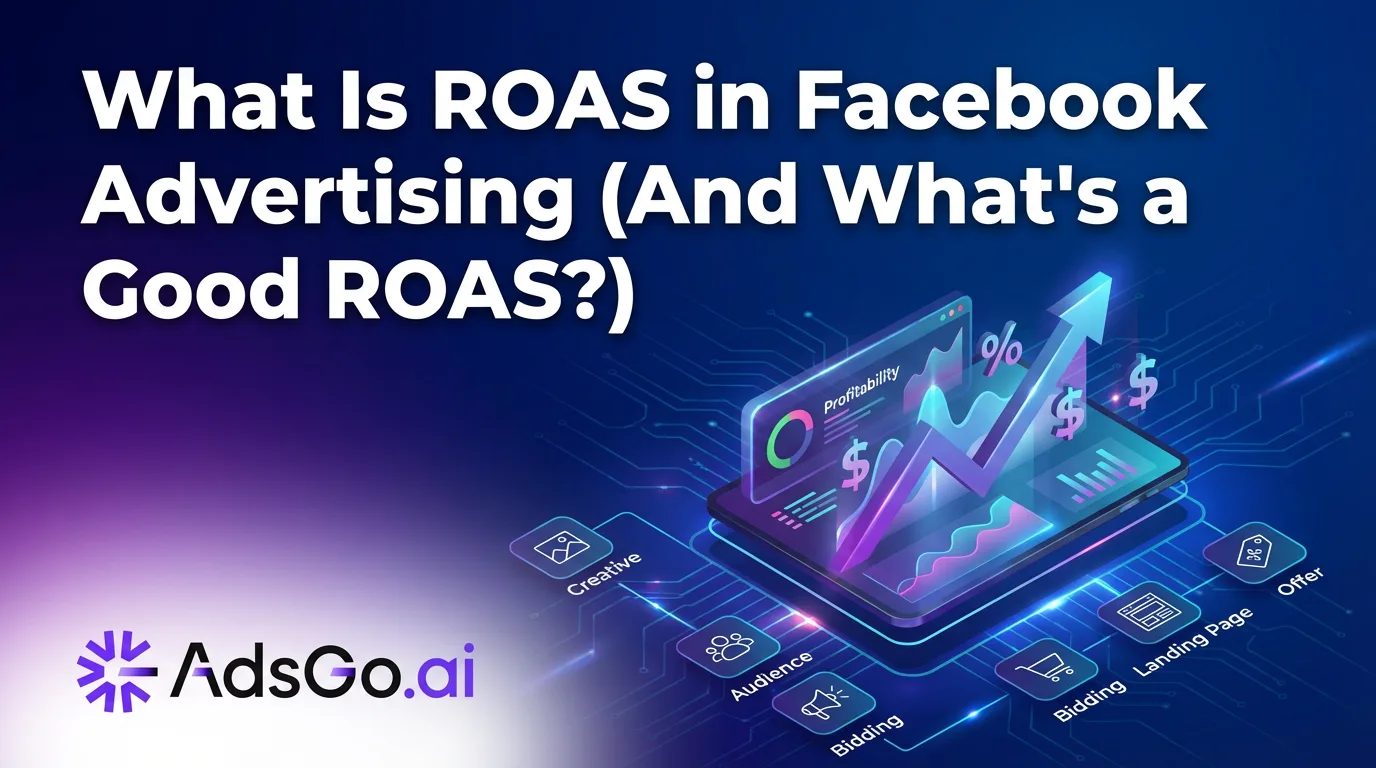
5 Factors That Influence Your Facebook Ads ROAS
1. Creative Quality
Your ad creative determines click-through rate, which directly affects cost per click and, ultimately, cost per acquisition. High-CTR creatives win auctions at lower CPMs, stretching your ad spend further and boosting ROAS. When creative fatigues — frequency rises and CTR drops — ROAS declines even if nothing else changes.
2. Audience Targeting Precision
Showing ads to people unlikely to buy is the fastest way to tank ROAS. Precise targeting — using Lookalike audiences seeded from your best customers, interest layering, and proper exclusions — ensures more of your spend reaches potential converters. Audience mismatch is the most common cause of poor ROAS from day one.
3. Bid Strategy and Budget Management
The wrong bid strategy can overpay for conversions or starve your best-performing campaigns. Matching bid strategy to campaign maturity (Lowest Cost for new campaigns, Cost Cap for scaling) and making gradual budget adjustments (15–20% every 3–4 days) keeps costs stable and ROAS predictable.
4. Landing Page Conversion Rate
ROAS is a function of both ad costs and conversion rates. If your landing page converts at 2% instead of 4%, you need twice as many clicks to generate the same revenue — effectively halving your ROAS. Speed, message match between ad and page, mobile optimization, and simplified checkout all directly impact this lever.
5. Product Pricing and Offer Strength
Even perfectly optimized ads can't overcome a weak offer. Average order value, pricing relative to competitors, and the perceived value of your offer set the revenue ceiling that ROAS is calculated against. Bundling, limited-time discounts, and free shipping thresholds can lift AOV and ROAS simultaneously.
For a full breakdown of how to systematically improve each of these factors, read our step-by-step guide on how to improve Facebook Ads ROAS. If cost reduction is your priority, our guide on how to reduce Facebook Ads cost covers the five proven levers for lowering CPM, CPC, and CPA.
Ready to Launch Smarter Campaigns?
How AdsGo Helps You Track and Improve ROAS
Automated Creative Rotation
Monitoring ROAS across multiple campaigns, ad sets, and audiences manually is time-consuming and reactive. By the time you notice a ROAS drop in Ads Manager, you've already wasted days of ad spend.
AdsGo's Ad Insight dashboard gives you real-time ROAS tracking with automated root-cause analysis — so you know not just that ROAS dropped, but why it dropped and which specific lever to fix first.
AI-Powered Optimization
AdsGo AI automates several key parts of this optimization workflow, removing the manual effort that slows most teams down.
- Cross-campaign ROAS monitoring — See blended and segment-level ROAS updated in real time across all active campaigns
- Root-cause alerts — AI identifies whether creative fatigue, audience mismatch, bidding inefficiency, or landing page friction is driving a ROAS decline
- Actionable recommendations — Instead of raw data, get prioritized next steps ranked by projected ROAS impact
Track your ROAS with AdsGo Ad Insight →
FAQ
What does a 4x ROAS mean?
A 4x ROAS means you earn $4 in revenue for every $1 you spend on advertising. If you invested $5,000 in Facebook Ads and generated $20,000 in tracked revenue, your ROAS is 4.0x. Whether that's profitable depends on your margins — for a business with 50% margins, 4x ROAS is highly profitable (break-even is 2.0x). For a business with 25% margins, 4x ROAS is just above break-even (3.0x would barely cover additional costs like shipping and overhead).
Is ROAS the same as ROI?
No. ROAS measures revenue relative to ad spend only. ROI measures profit relative to total investment — including product costs, fulfillment, overhead, and ad spend. A campaign can have a positive ROAS but a negative ROI if the product margins are thin. Always calculate break-even ROAS (1 ÷ profit margin) to understand your true profitability threshold.
Why is my Facebook Ads ROAS so low?
Low ROAS traces back to one of four root causes: poor creative performance driving up costs (high frequency, declining CTR), audience targeting mismatch (showing ads to people unlikely to convert), inefficient bid strategy (overpaying in auctions), or low landing page conversion rate (losing visitors after the click). Diagnose which cause applies by checking your frequency, CTR, CPM, and on-site conversion rate trends. Our full ROAS improvement guide walks through the diagnostic framework step by step.
How do I find my ROAS in Facebook Ads Manager?
Navigate to Ads Manager, click "Columns," and select "Customize Columns." Search for "Purchase ROAS" and add it to your report. This column requires the Meta Pixel or Conversions API to be properly installed with purchase event values. If you only track leads (not purchases), you'll need to calculate ROAS manually by matching downstream revenue to ad spend in your CRM.
My ROAS looks great but I'm still losing money — how?
ROAS only measures ad spend vs. revenue. It doesn't account for COGS, shipping, returns, or overhead. A 3x ROAS sounds good, but if your margins are 25%, you're actually breaking even. Always cross-reference ROAS with your net profit margin.
Want to see how AI handles this automatically? AdsGo AI manages your Google and Meta ads end-to-end — no experience needed.