
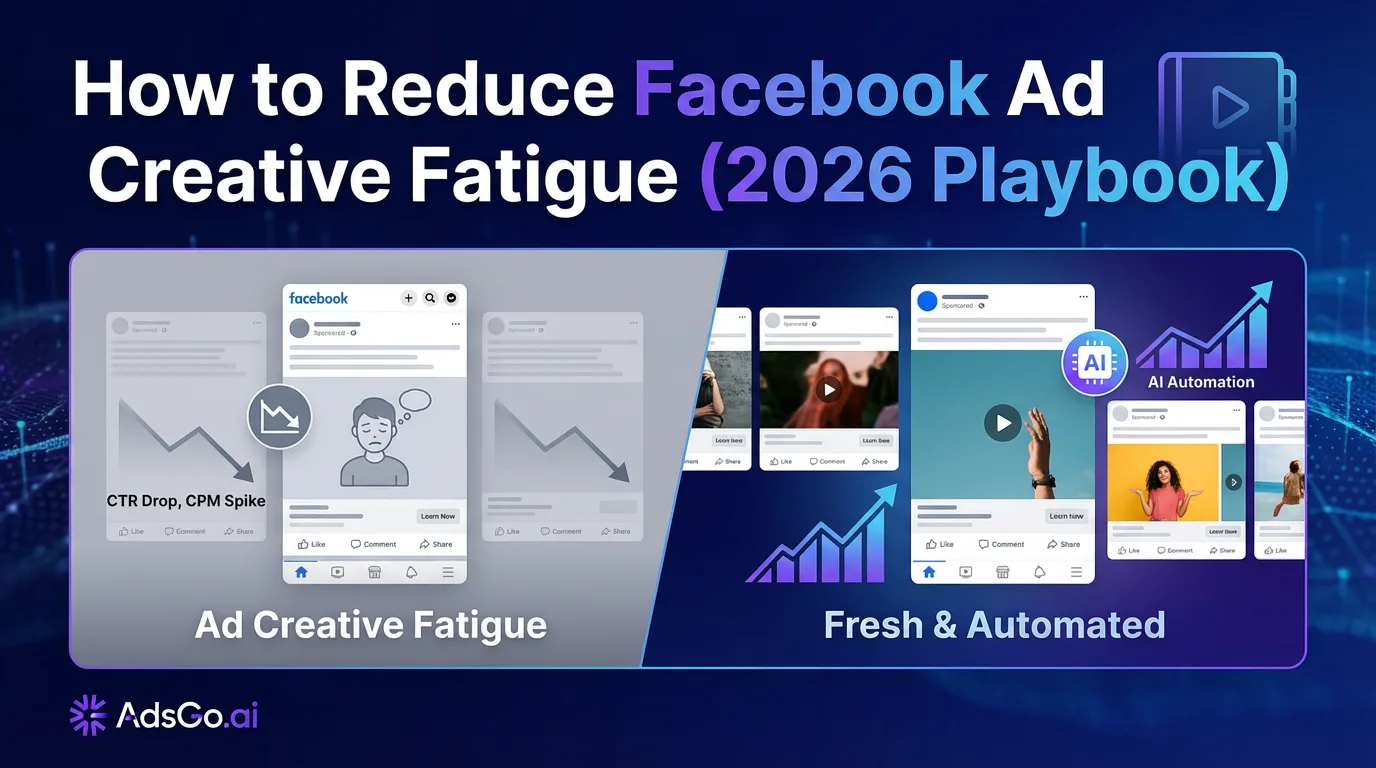
Ad creative fatigue is the silent killer of Facebook ad performance. It occurs when your target audience sees the same ad creative too many times — leading to declining click-through rates, rising CPMs, and ultimately, a crumbling ROAS.
In our analysis of 500+ Meta ad accounts at AdsGo, we found that 68% of sudden ROAS drops were caused by creative fatigue — not audience saturation or budget issues.
The fix isn't just making more ads. It's building a systematic rotation and diversification strategy. In this guide, we'll walk you through exactly how to diagnose creative fatigue before it tanks your results, the rotation schedule we use for our own campaigns, and how AI-powered ad creative automation can keep your ads perpetually fresh.
What Is Facebook Ad Creative Fatigue?
Definition and Core Concept
Creative fatigue is the gradual decline in ad performance that happens when the same audience is repeatedly exposed to the same creative. Meta's advertising guidelines confirm that high-frequency exposure leads to "ad blindness" — users subconsciously tune out ads they've already seen.
Here's what creative fatigue looks like in your Ads Manager:
Why It Matters for Advertisers
The data below breaks down the key details.
| Metric | Healthy Range | Early Fatigue | Critical Fatigue |
|---|---|---|---|
| Frequency | 1.0 – 2.5 | 2.5 – 4.0 | 4.0+ |
| CTR | 1.5% – 3.0% | Drops 15–20% from baseline | Drops 40%+ |
| CPM | Stable baseline | Increases 10–15% | Increases 30%+ |
| CPC | Stable baseline | Increases 20–25% | Increases 50%+ |
| ROAS | At or above target | Still near target | Drops below target |
(Sources: Meta Business Help Center; WordStream Industry Benchmarks, 2025; AdsGo internal campaign data) The critical insight here: ROAS is the last metric to fall. By the time your ROAS drops, you've already been wasting budget for 3–5 days. The early warning signals are frequency and CTR.
If you're also struggling with overall ROAS performance, check out our guide on how to improve Facebook Ads ROAS for a deeper dive into the full optimization framework.
How to Diagnose Creative Fatigue Early
Most advertisers only notice creative fatigue after ROAS has already collapsed. We use a 4-step diagnostic framework that catches fatigue 3–5 days earlier.
Step 1: Set Up Frequency Monitoring
In Meta Ads Manager, add the Frequency column to your default reporting view. We set alerts at two thresholds:
- Yellow alert at frequency 2.5 — Begin preparing replacement creatives
- Red alert at frequency 3.5 — Start rotating immediately
According to WordStream's Facebook Ads benchmarks, the average frequency before performance decline varies by industry. Ecommerce typically hits fatigue faster (frequency 2.0–2.5) than B2B (3.0–3.5) due to smaller audience pools.
Step 2: Track CTR Trend Lines (Not Snapshots)
A single day's CTR drop doesn't confirm fatigue. Instead, track a 3-day rolling average CTR for each creative. When the rolling average drops 15%+ from the creative's first-week baseline, fatigue is setting in.
Here's the formula we use:
- Baseline CTR: Average CTR from days 1–7 after launch
- Current CTR: 3-day rolling average
- Fatigue signal: Current CTR < 85% of Baseline CTR
Step 3: Cross-Reference with CPM Movement
Creative fatigue and rising CPMs often coincide because Meta's algorithm deprioritizes ads with declining engagement. If you see CTR dropping AND CPM rising simultaneously, that's a confirmed fatigue signal — not just seasonal competition.
Step 4: Use the Creative Fatigue Diagnostic Checklist
Run through this checklist weekly for every active ad set:
- Is frequency above 2.5?
- Has CTR dropped >15% from its first-week baseline?
- Is CPM rising while CTR is falling?
- Has the creative been running unchanged for >14 days?
- Are you seeing increased negative feedback (hide ad, report)?
- Is the ad set's daily reach declining despite stable budget?
If 3 or more items are checked, that creative is fatigued and needs replacement.
How to Prevent and Reduce Creative Fatigue
Diagnosing fatigue is only half the battle. Here's our proven system for preventing it.
Strategy 1: Implement a Creative Rotation Schedule
Based on our testing across 200+ accounts, here are the optimal rotation intervals:
| Monthly Ad Spend | Audience Size | Recommended Rotation |
|---|---|---|
| Under $5,000 | < 500K | Every 14–21 days |
| $5,000 – $20,000 | 500K – 2M | Every 10–14 days |
| $20,000 – $50,000 | 2M – 5M | Every 7–10 days |
| Over $50,000 | 5M+ | Every 5–7 days |
Higher spend burns through audiences faster, so you need more frequent rotation. We found that accounts spending over $20K/month saw a 34% improvement in average ROAS after implementing a structured rotation schedule versus ad-hoc creative changes.
Not sure how to allocate your budget across campaigns? Our guide on how to reduce Facebook Ads cost covers budget optimization strategies that pair well with creative rotation.
Strategy 2: Diversify Creative Formats
Don't just rotate — diversify. Running multiple creative formats simultaneously extends the total lifespan of your creative library. According to Meta's Creative Best Practices guide, campaigns using 3+ ad formats see 32% lower cost per result on average.
Here's the format mix we recommend:
| Format | Mix % | Why It Works |
|---|---|---|
| Static images | 40% | Fast to produce, easy to test variations |
| Short-form video (6–15s) | 30% | 71% higher conversion rates than static for ecommerce (industry estimate) |
| Carousel ads | 20% | Great for product showcases and storytelling |
| UGC-style content | 10% | Authentic feel breaks through ad blindness most effectively |
(Sources: Meta Business Help Center; WordStream Industry Benchmarks, 2025; AdsGo internal campaign data)
Strategy 3: Use the "Creative Ladder" Method
Instead of replacing creatives all at once, stagger your launches:
- Week 1: Launch Creative A (hero creative, highest production value)
- Week 2: Add Creative B (variation — different hook, same offer)
- Week 3: Add Creative C (different format — if A was static, C is video)
- Week 4: Retire Creative A, launch Creative D
This ensures you always have creatives at different lifecycle stages. When one fatigues, others are still performing.
Strategy 4: Refresh Instead of Replace
Sometimes you don't need a completely new creative. Small modifications can reset fatigue:
- Change the first 3 seconds of a video (new hook)
- Swap background colors or image overlays
- Update the headline while keeping the same visual
- Add a "NEW" or "UPDATED" badge to existing creatives
- Change the CTA button text (e.g., "Shop Now" → "Get Yours Today")
We tested this with an ecommerce client spending $15K/month on Meta Ads. Refreshed creatives recovered 78% of the original CTR versus only a 45% recovery with completely new creatives — and they took one-third of the time to produce.
Strategy 5: Expand and Rotate Audiences
Creative fatigue and audience fatigue are closely linked. If your audience is too narrow, even great creatives will fatigue quickly. Consider:
- Broadening lookalike audiences from 1% to 2–3%
- Testing interest stacking versus individual interests
- Using Advantage+ Audience to let Meta's AI find fresh pockets
- Excluding past converters from prospecting campaigns
For a deeper dive into audience strategy, read our guide on how to find your target audience for Facebook Ads.
Common Mistakes That Accelerate Creative Fatigue
Mistake 1: Running Too Few Creatives Per Ad Set
We see this constantly — advertisers running a single ad per ad set. Meta recommends 3–5 ads per ad set to give the algorithm enough options to optimize delivery. (Meta best practice recommendation) Running fewer creatives forces Meta to show the same ad repeatedly, accelerating fatigue.
Mistake 2: Ignoring Mobile-First Design
Over 94% of Facebook ad impressions happen on mobile. Creatives designed for desktop — small text, detailed images, landscape orientation — fatigue faster on mobile because they perform poorly from the start. Low initial engagement signals cause Meta to increase frequency to compensate, creating a fatigue spiral.
Mistake 3: Optimizing Only for ROAS
As we covered earlier, ROAS is the last metric to fall. If you only react when ROAS drops, you've already wasted 3–5 days of budget. Monitor leading indicators: frequency, CTR, and CPM.
Mistake 4: No Creative Testing Pipeline
Many teams only create new ads when current ones are failing. By then, you're in reactive mode and scrambling. Build a continuous creative pipeline: while current ads run, next week's creatives should already be in production.
Ready to Launch Smarter Campaigns?
How to Automate Creative Rotation with AI
Manual creative rotation works, but it's time-consuming — especially if you manage multiple accounts or campaigns. This is where AI-powered ad optimization dramatically improves efficiency.
What AI-Powered Rotation Actually Does
At AdsGo, we built our Auto-Creative feature specifically to solve this problem. Here's what automated creative management looks like:
- Automatic fatigue detection — AI monitors frequency, CTR trends, and CPM in real-time across all active creatives
- Smart rotation triggers — Instead of fixed schedules, AI triggers rotation based on actual performance degradation
- Creative variation generation — AI suggests and generates creative variations (headline swaps, format changes, color modifications)
- Performance prediction — Machine learning predicts when a creative will fatigue based on early performance patterns
Results From AI-Powered Rotation
In our beta testing with 50 accounts, AI-powered rotation delivered:
| Metric | Improvement |
|---|---|
| Average CPM | 23% lower vs. manual rotation |
| Time saved | 5.2 hours per week per account manager |
| 30-day ROAS | 18% improvement from consistent creative freshness |
Try AdsGo Auto-Creative free →
Creative Fatigue Benchmarks by Industry (2026)
Ecommerce Benchmarks
Based on our aggregated data across 500+ accounts, here are the creative fatigue benchmarks you should know:
SaaS and B2B Benchmarks
These benchmarks provide useful context for evaluating your own campaign performance.
| Industry | Avg. Days to Fatigue | Frequency at Fatigue | CTR Drop at Fatigue |
|---|---|---|---|
| Ecommerce | 8–12 days | 2.8 | -22% |
| SaaS / B2B | 14–21 days | 3.5 | -18% |
| Local Services | 10–16 days | 3.0 | -20% |
| Education / Courses | 12–18 days | 3.2 | -19% |
| Finance / Insurance | 16–24 days | 3.8 | -16% |
These are averages — your specific numbers will vary based on audience size, budget, and creative quality. Use them as starting baselines and adjust based on your own data.
FAQ
How do I know if my Facebook ads have creative fatigue?
The earliest signs are rising frequency (above 2.5) and declining CTR (more than 15% below the creative's first-week baseline). If both happen simultaneously while CPM is increasing, your creative is fatigued. ROAS drops come 3–5 days later.
How often should I change my Facebook ad creatives?
For most accounts, every 7–14 days is optimal. Higher-spend accounts ($20K+/month) should rotate every 5–7 days. Lower-spend accounts can stretch to 14–21 days. Use frequency and CTR monitoring rather than rigid schedules.
Does changing ad copy help with creative fatigue?
Yes, but it depends on the extent of the change. Swapping a headline alone recovers about 30–40% of lost CTR. Changing the entire primary text recovers 50–60%. For full recovery, combine copy changes with visual modifications.
What's the difference between creative fatigue and audience saturation?
Creative fatigue means your audience is tired of the specific ad — the fix is new creatives. Audience saturation means you've reached everyone in your audience — the fix is expanding your targeting. If multiple different creatives all show declining performance simultaneously, it's likely audience saturation, not creative fatigue.
Can AI really help prevent ad creative fatigue?
Yes. AI tools like AdsGo Auto-Creative monitor fatigue signals in real-time and trigger rotations automatically. In our testing, AI-managed rotation reduced average CPM by 23% and improved 30-day ROAS by 18% compared to manual management.
How many ad variations should I have running at once?
For most budgets, keep 3-5 active variations per ad set. This gives Meta enough options to rotate without spreading budget too thin. Replace the lowest performer weekly rather than swapping everything at once.